

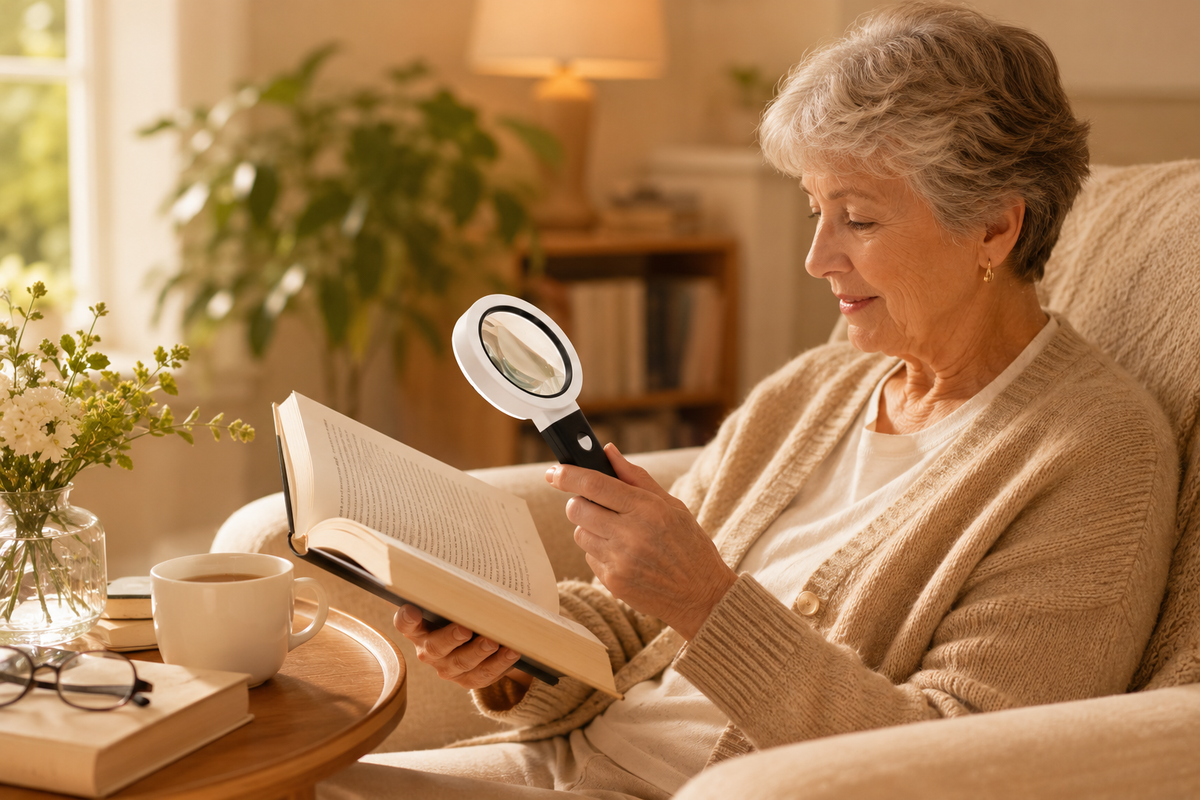
Reading a book, newspaper, letter, menu, or product label should not become a struggle simply because the print is small. A reading magnifier can make text easier to see by enlarging the page and, when equipped with built-in lighting, improving visibility in dim environments.
But choosing the right magnifier for reading is not simply about finding the highest magnification. A lens that is too small, too powerful, or difficult to hold can make reading more frustrating rather than easier.
So, what is the best magnifier for reading books and small print? For most everyday reading, the best choice balances magnification, lens size, optical clarity, lighting, comfort, and ease of use.
This guide explains what to look for when choosing a reading magnifier and how to match different magnifier designs to books, newspapers, mail, labels, and other everyday reading tasks.
What Is the Best Magnifier for Reading?
The best magnifier for reading is one that makes text noticeably easier to see while still giving you a comfortable viewing area and enough working distance to move naturally across a page.
For extended reading, a large-area magnifier with moderate magnification is often more practical than a very high-power lens. A larger viewing area allows you to see more words at once, which means less repositioning as you move across a page.
If you frequently read in low light, a magnifying glass with built-in LED light can be especially useful because it combines magnification with focused illumination.
For people with significant vision loss, a magnifier can be one part of a broader low-vision strategy. The National Eye Institute recommends magnifying lenses for reading and other close-up activities and notes that vision rehabilitation specialists can provide training on how to use magnifying devices effectively. Learn more about low vision from the National Eye Institute.
How to Choose a Magnifier for Reading
Before buying a reading magnifier, consider what you read most often, how long you typically read, and whether you need your hands free.
1. Choose the Right Magnification
Magnification is one of the first specifications shoppers notice, but more magnification is not automatically better for reading.
Higher magnification generally means a smaller field of view and a shorter working distance. That can be useful when examining very small details, but it may require more frequent repositioning when reading a full page.
| Magnification Level | Best For | What to Consider |
|---|---|---|
| Low to moderate | Books, newspapers, magazines, letters | Better for viewing more text at once |
| Moderate to higher | Small print, labels, instructions | Useful when text is particularly difficult to see |
| High magnification | Very small details, hobbies, close inspection | Usually provides a smaller viewing area |
For continuous reading, prioritize usable viewing area and comfort rather than simply choosing the highest number on the package.
2. Look for a Large Viewing Area
Lens size is especially important when choosing a magnifier for reading books.
A small handheld magnifier may work well for checking a price tag or a single line of small print, but reading several paragraphs requires constant movement if the lens covers only a small portion of the page.
A larger page magnifier can show more text at once and reduce the amount of repositioning required. This makes a large viewing area particularly useful for:
- Reading books
- Reading newspapers and magazines
- Checking letters and documents
- Reading menus
- Reviewing printed instructions
- Following recipes
For longer reading sessions, lens size can be just as important as magnification strength.
3. Consider a Magnifying Glass With Light
Lighting can make a major difference when reading small print.
A lighted magnifier combines an optical lens with built-in illumination, helping brighten the area directly beneath the lens. This can be especially convenient when reading at night, in a dim room, or in places where adjusting the surrounding lighting is difficult.
When comparing a magnifying glass with light for reading, look for:
- Even illumination across the viewing area
- LED lighting for efficient operation
- A light that does not create distracting glare
- Easy-to-use light controls
- A convenient battery or rechargeable power source
Some current reading-magnifier designs combine large lenses with multiple LEDs and adjustable lighting specifically to make books and small print easier to view.
4. Choose a Comfortable Lens Design
Optical quality matters because a magnifier should enlarge text without making the page appear unnecessarily distorted.
When comparing different models, pay attention to:
- Lens clarity
- Edge distortion
- Lens size
- Lens material
- Overall weight
A lightweight lens can be more comfortable for handheld use, while a larger lens may be preferable when your primary goal is reading books and other full-page materials.
5. Decide Between Handheld and Hands-Free Magnifiers
There is no single magnifier design that is best for everyone. Your preferred reading position and how long you read should influence the choice.
Handheld Magnifiers
Handheld magnifiers are flexible and portable. They are convenient for quickly checking small print on mail, labels, menus, packaging, or books.
They are a good choice if you want a magnifier that can easily move from room to room or fit into a bag.
Stand or Hands-Free Magnifiers
Hands-free designs can be more convenient for longer reading sessions because the magnifier does not need to be held continuously.
They can also be useful for people who want both hands available to turn pages, write notes, complete puzzles, or work on crafts.
If you mainly read for short periods, a handheld model may be sufficient. If you regularly spend longer periods reading or doing close-up activities, a hands-free design may be worth considering.
What Type of Magnifier Is Best for Reading Books?
For reading books, the most useful design is generally one that provides a wide viewing area, comfortable magnification, clear optics, and adequate illumination.
A compact high-power magnifier can enlarge individual words dramatically, but it may not be the most comfortable option for reading several pages.
For books and newspapers, think about the reading experience rather than the maximum magnification number. You want to be able to move naturally from one line to the next without constantly searching for the next section of text.
What Is the Best Magnifier for Small Print?
The best magnifier for small print depends on how small the text is and how you plan to use the magnifier.
For occasional small print on packaging, menus, mail, and instructions, a handheld magnifier with built-in lighting can be practical.
For extremely small details, a higher-power magnifier may provide more enlargement. However, higher magnification can reduce the viewing area, so it is usually better suited to short inspection tasks than continuous reading.
If your primary task is reading books, choose a model optimized for a wider field of view. If your primary task is checking tiny labels or individual details, a more compact high-power lens may be more appropriate.
Do You Need a Lighted Magnifier for Reading?
A lighted magnifier is not essential for every reader, but it can be a useful choice when lighting conditions vary.
Built-in illumination is particularly helpful when:
- You often read in the evening.
- Your room lighting is uneven.
- You read in restaurants or other dim environments.
- You frequently check small print on labels or packaging.
- You want the light source to move with the magnifier.
For longer reading sessions, a combination of clear magnification and comfortable lighting is generally more useful than either feature alone.
Magnifier for Reading vs. Magnifier for Close Inspection
Not every magnifier is designed for the same task.
| Feature | Reading Magnifier | Close-Inspection Magnifier |
|---|---|---|
| Primary use | Books, newspapers, documents | Labels, small details, hobbies |
| Viewing area | Usually larger | Often smaller |
| Magnification | Moderate and comfortable | Can be higher |
| Portability | Varies by design | Often compact |
| Lighting | Very useful | Useful for detailed inspection |
| Best for long reading | Yes | Usually less suitable |
Common Mistakes When Buying a Reading Magnifier
Choosing the Highest Magnification
It is easy to assume that a higher number means a better magnifier. For reading, that is not always true. Excessive magnification can reduce the visible area and make it harder to follow continuous text.
Ignoring Lens Size
A magnifier with excellent magnification but a tiny lens may require constant repositioning across a book page. Consider the amount of text you want to see at once.
Forgetting About Lighting
A magnifier cannot make a page easier to read if the surrounding conditions are too dark. If you regularly read in low-light environments, built-in illumination can be a practical feature.
Choosing a Design That Is Uncomfortable to Hold
If you plan to use a handheld magnifier for extended periods, weight and handle design matter. A magnifier that is difficult to hold comfortably may end up being used less often.
Buying Based Only on Price
The cheapest option is not necessarily the best value. Look at the combination of lens size, optical clarity, lighting, ergonomics, power source, and intended use before comparing prices.
Quick Buying Checklist for a Reading Magnifier
Before purchasing, ask yourself these questions:
- Will I mainly read books and newspapers or inspect tiny details?
- Do I need to see several words or lines at once?
- Do I frequently read in low light?
- Would built-in LED lighting be useful?
- Do I prefer handheld or hands-free use?
- How long do I normally read at one time?
- Do I need a lightweight design?
- Is the lens large enough for my typical reading material?
- Is the magnification appropriate for continuous reading?
Answering these questions can narrow your choices much faster than simply searching for the highest magnification available.
How to Choose the Right Magnifier for Different Reading Tasks
| Reading Task | Recommended Features |
|---|---|
| Books | Large viewing area, comfortable magnification, clear lens |
| Newspapers | Wide lens, good illumination, lightweight design |
| Mail and letters | Portable handheld design, moderate magnification |
| Medication labels | Higher magnification option, built-in light |
| Menus | Portable, lightweight, illuminated lens |
| Crosswords and puzzles | Clear optics, comfortable viewing area, hands-free option |
| Small print on packaging | Good illumination and stronger magnification |
When Should You Consider Professional Vision Support?
A magnifier can be a useful reading aid, but it should not replace an eye examination when vision changes are persistent or interfere with everyday activities.
If you are having increasing difficulty reading even with a magnifier, or if changes in vision are affecting daily life, consider discussing your needs with an eye-care professional. The National Eye Institute notes that people whose vision loss interferes with everyday activities may benefit from vision rehabilitation and professional guidance on using magnifying devices.
A professional assessment can help determine whether a standard magnifier is appropriate or whether a specialized low-vision device would better match your needs.
Frequently Asked Questions About Magnifiers for Reading
What is the best magnifier for reading books?
The best magnifier for reading books usually combines a comfortable level of magnification with a large viewing area, clear optics, and good lighting. A larger lens is often more practical for continuous reading because you can see more text at once.
What magnification is best for reading?
There is no single magnification that works for everyone. Lower or moderate magnification is generally easier for continuous reading because it provides a wider viewing area, while higher magnification is more useful for very small details.
Is a magnifying glass with light better for reading?
A lighted magnifier can be a better choice when you frequently read in dim or uneven lighting. Built-in illumination helps brighten the page while the lens enlarges the text.
What is the best magnifier for small print?
The best magnifier for small print depends on how small the text is and how frequently you need to read it. A lighted handheld magnifier can be convenient for labels, menus, mail, and packaging, while a larger page magnifier may be more comfortable for books and longer documents.
Is a higher-power magnifier better?
Not necessarily. Higher magnification can make very small details easier to see, but it can also reduce the viewing area and require more precise positioning. For continuous reading, usability and field of view are just as important as magnification strength.
Should seniors use a magnifier for reading?
A magnifier can be a useful reading aid for seniors who have difficulty seeing small print. The right design depends on the individual's reading needs, preferred format, lighting conditions, and level of visual difficulty.
Are LED magnifiers good for reading books?
Yes. LED magnifiers can be particularly useful for book reading when the room is dim or the printed text has low contrast. A large lens combined with even LED illumination can make it easier to follow text across a page.
Final Thoughts: Finding the Best Magnifier for Reading
The best magnifier for reading is not necessarily the one with the highest magnification. For books, newspapers, and longer reading sessions, lens size, viewing area, optical clarity, lighting, and comfort can make a bigger difference to the overall experience.
If you mainly read books, prioritize a larger viewing area and comfortable magnification. If you frequently check tiny labels or small print, consider a stronger magnification option. And if you often read in dim environments, a magnifying glass with built-in LED lighting can provide added convenience.
Most importantly, choose a magnifier based on how you actually read. The right balance of magnification, visibility, portability, and comfort can make everyday reading easier without forcing you to constantly reposition the lens.
Looking for more options? Explore our guide to the best magnifiers for seniors to compare magnifier types and find an option suited to your everyday needs.
Share:
Best Walking Canes for Balance: Top Picks for Stability and Support
Best Manual Wheelchairs in 2026: Top Picks for Comfort, Mobility & Everyday Use